
Robotics and Artificial Intelligence: From Smart Robots to Intelligent Machines
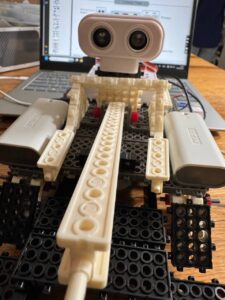
Robotics and Artificial Intelligence (AI) are transforming the way we live, work and interact with technology. From smart home devices and autonomous vehicles to medical robots, space exploration and intelligent machines, robotics is moving rapidly from specialised industrial applications into everyday life.
At Matris Robotic, we believe that understanding this transformation starts with understanding the fundamentals: What is a robot? What is intelligence? How do robots move? And how can machines learn to make decisions?
This article introduces the fascinating connection between robotics and artificial intelligence, from the basic structure of a robot to advanced topics such as kinematics, control, reinforcement learning and spiking neural networks.
The Robotic Revolution
We are already experiencing the beginning of a new era of robotisation.
Smart home systems such as Alexa demonstrate how intelligent technology can interact with people and their environment. Autonomous vehicles, such as Tesla’s vehicles, show how the concept of a car is evolving toward that of a mobile robotic system.
The next stage is likely to involve robots becoming increasingly common in our homes and everyday environments. At the same time, service robots are opening new possibilities for automation in areas that were traditionally performed entirely by humans.
This transformation is also creating new opportunities for engineers, programmers, designers and AI specialists.
The Artificial Intelligence Revolution
Robotics is developing alongside another major technological transformation: the Artificial Intelligence revolution.
AI systems such as ChatGPT demonstrate how machines can process information, communicate with humans and perform increasingly sophisticated cognitive tasks. Research into the human brain and intelligent behaviour is also influencing the development of new forms of artificial intelligence.
The future may involve increasingly sophisticated intelligent systems and, potentially, research into artificial consciousness.
These developments are creating opportunities in areas such as:
- Smart robots
- Artificial intelligence
- Financial analysis
- Virtual and digital environments
- Autonomous systems
- Human-machine interaction
The combination of AI and robotics is particularly powerful because AI can provide the intelligence while robotics provides a physical body capable of interacting with the real world.
What Is a Robot?
A robot can be described as a reprogrammable, multifunctional manipulator designed to move materials, parts, tools or specialised devices through programmed motions to perform a variety of tasks.
In simpler terms, a robot is a machine that can be programmed to perform physical actions.
Robots can be designed for very different environments and purposes. They may manipulate objects in a factory, assist medical professionals, explore dangerous environments, travel through space or interact directly with people.
But physical movement alone does not necessarily make a machine intelligent.
What Is Intelligence?
Intelligence involves capabilities such as:
- Abstraction
- Logic
- Understanding
- Learning
- Reasoning
- Planning
- Creativity
- Critical thinking
- Problem-solving
- Self-awareness
- Emotional knowledge
Artificial Intelligence attempts to reproduce or simulate some of these capabilities in machines.
When robotics and AI are combined, robots can potentially move beyond simply following fixed instructions and begin to respond intelligently to their environment.
Where Are Robots Used?
Robotics has applications across a remarkably wide range of industries.
Medical Robotics
Robots are increasingly important in medical science. They can support highly precise physical tasks and provide new possibilities for healthcare and biomedical research.
The combination of robotics, sensing and AI has the potential to transform the way medical procedures and healthcare services are delivered.
Manufacturing and Automation
Manufacturing is one of the most established applications of robotics.
Industrial robots can perform repetitive and precise tasks such as:
- Assembly
- Material handling
- Automated production
- Inspection
- Manufacturing processes
Automation allows robots to perform tasks repeatedly with consistent programmed movements.
Biotechnology
Robotics also plays an important role in biotechnology.
Robotic systems can be used for:
- Micro- and nano-manipulation
- Sample handling
- Automated analysis
At these scales, precise robotic manipulation can be particularly valuable because many operations are difficult or impossible to perform reliably by hand.
Fire Fighting and Rescue
Robots can operate in dangerous environments where sending a human may be unsafe.
Fire-fighting and rescue robots can potentially enter hazardous areas, collect information and perform physical tasks while keeping people away from immediate danger.
Space Exploration
Space is another important application of robotics.
Robots can explore environments that are extremely distant, hostile or inaccessible to humans. Robotic systems therefore play an important role in space exploration and scientific research.
Field Robots
Unlike robots operating in carefully controlled factories, field robots must operate in less predictable environments.
They may need to navigate uneven terrain, respond to changing surroundings and make decisions based on sensor information.
Service and Entertainment Robots
Robotics is also moving into everyday life through service and entertainment robots.
These systems are designed to interact more directly with people and their environments, creating new possibilities for education, assistance, entertainment and domestic applications.
Understanding How Robots Move
To understand robotics properly, we need to understand the mechanical structure that allows a robot to move.
One of the fundamental concepts is the robot joint.
Different types of joints provide different forms of movement. For example:
- A revolute joint provides one rotational degree of freedom.
- A prismatic joint provides one linear degree of freedom.
- A spherical joint can provide multiple rotational degrees of freedom.
These joints form the mechanical structure of robotic manipulators.
Robot Configurations
Robotic manipulators can have different configurations depending on the arrangement of their joints.
Common configurations include:
Cartesian robots — PPP
Three prismatic joints provide linear movements along different axes.
Cylindrical robots — RPP
A combination of rotational and linear joints produces a cylindrical workspace.
Spherical robots — RRP
The arrangement of joints produces a spherical-type workspace.
SCARA robots — RRP
SCARA stands for Selective Compliance Assembly Robot Arm and is widely associated with assembly applications.
Articulated robots — RRR
Articulated robots use rotary joints arranged similarly to a human arm and are among the most recognisable industrial robot configurations. For a practical introduction to industrial robotics, the British Automation & Robot Association (BARA) provides a useful guide covering industrial robot applications, robot types, AI and machine vision, sensors, programming, safety and current trends in industrial automation. For more information about industrial robots, see this link.
What Is a Robot’s Workspace?
A robot cannot reach every point in the world.
Its workspace represents the total volume or area that its end-effector can reach through its possible movements.
The shape and size of this workspace depend on the robot’s mechanical structure, joint configuration and physical dimensions.
Understanding workspace is essential when designing robotic systems because it determines where the robot can perform a task.
Forward Kinematics: Where Is the Robot’s End-Effector?
One of the fundamental problems in robotics is determining where the robot’s end-effector is located.
Forward kinematics calculates the position and orientation of the robot’s end-effector from its joint variables.
In other words:
Known joint positions → Calculate end-effector position and orientation
For example, if we know the angles of the joints of a robotic arm, forward kinematics allows us to determine where the robot’s hand or tool is located.
This is one of the foundations of robotic manipulation and control.
Inverse Kinematics: How Should the Robot Move?
The opposite problem is known as inverse kinematics.
Here, we start with the desired position and orientation of the robot’s end-effector and need to determine the joint variables required to reach it.
The relationship can be summarised as:
Desired end-effector position → Calculate required joint variables
Inverse kinematics is particularly important for robotic arms because applications often specify where a tool needs to go rather than directly specifying the angle of every joint.
For complex robots, solving inverse kinematics can become mathematically challenging because there may be multiple possible solutions—or no valid solution—for a desired position.
The Jacobian Matrix
Another fundamental concept in robotics is the Jacobian matrix.
The Jacobian describes the relationship between changes in the robot’s joint variables and changes in the position and orientation of its end-effector.
It is particularly important for understanding instantaneous kinematics.
An important point is that the Jacobian is a function of the robot’s joint configuration. In other words, the Jacobian is not a constant.
As the robot moves, its configuration changes, and therefore its Jacobian changes as well.
The inverse Jacobian can also be used in robotic motion and control problems, allowing relationships between end-effector motion and joint motion to be analysed.
From Kinematics to Robot Control
Understanding where a robot is and how it moves is only part of robotics.
The next challenge is control.
A robot controller needs to determine how the robot should move its joints to achieve a desired behaviour.
This creates a connection between:
Position → Motion → Control → Behaviour
Traditional robot control can be based on mathematical models of the robot and its environment. However, AI introduces another possibility: allowing robots to learn behaviours from interaction with their environment.
Reinforcement Learning: Learning Through Rewards
One important approach to AI-based robot learning is reinforcement learning.
In reinforcement learning, a system is not necessarily told exactly what output should be produced for every input. Instead, it receives feedback from the environment.
Good behaviours receive rewards, while undesirable behaviours receive punishment.
The system then attempts to learn which behaviours lead to higher rewards and lower punishment.
The basic idea can be represented as:
Environment → Robot → Action → Feedback → Learning
This approach is particularly interesting for robotics because robots operate in physical environments where their actions have consequences.
Instead of programming every possible situation manually, a robot can potentially learn which behaviours are useful through interaction.
Reinforcement Learning and the Brain
Research into biological intelligence has also influenced reinforcement learning.
Some parts of the brain are thought to implement mechanisms related to reinforcement learning, with dopamine playing an important role in reward prediction.
This connection between neuroscience, AI and robotics provides an exciting research direction for developing new intelligent robotic systems.
Spiking Neural Networks
One advanced approach to artificial intelligence is the Spiking Neural Network (SNN).
Unlike many conventional artificial neural networks, spiking neural networks are inspired more directly by the way biological neurons communicate through discrete electrical spikes.
This makes SNNs particularly interesting when studying the relationship between biological intelligence and artificial systems.
Spiking architectures can be investigated for applications in intelligent robotics, especially where efficient processing of sensory information and learning from interaction are important.
Research in this area has explored reinforcement learning in mobile robots through spiking architectures inspired by biological brain circuitry.
The Future of Robotics and AI
The development of robotics and AI is not happening in isolation.
Robotics brings together:
- Mechanical engineering
- Electronics
- Control engineering
- Computer programming
- Artificial intelligence
- Mathematics
- Neuroscience
The future of intelligent machines will increasingly depend on the integration of these disciplines.
A robot needs a physical body capable of movement. It needs sensors to understand its environment. It needs control systems to coordinate its actions. And increasingly, it needs AI to interpret information, learn and make decisions.
This is why robotics is such a powerful multidisciplinary field.
Why Learn Robotics and AI?
Learning robotics is not simply about building a robot.
It is an opportunity to understand how different areas of engineering and computer science work together to create intelligent machines.
Students who learn robotics can develop skills in:
- Programming
- Electronics
- Mechanical design
- Mathematics
- Problem-solving
- Control systems
- Artificial intelligence
- Computational thinking
- Engineering design
More importantly, robotics provides a practical environment in which students can experiment, make mistakes, test ideas and see the results of their decisions in the physical world.
From Robots to Intelligent Machines
The evolution of robotics can be viewed as a journey.
We began with machines designed primarily to perform programmed physical tasks. Robotics then developed toward greater automation, sensing and control. Artificial intelligence is now adding another layer: the ability for machines to learn from data and interaction.
The next generation of robots will increasingly combine movement, perception, learning and intelligence.
Understanding the fundamentals today—from robot joints and workspace to kinematics, control and reinforcement learning—provides the foundation for understanding the intelligent robotic systems of tomorrow.
At Matris Robotic, we believe that introducing young people to these ideas through practical, hands-on learning can help them become not just users of future technology, but the engineers, programmers and innovators who create it. Explore our Robotics Courses for Kids.