
Robot Kinematics Explained: Forward and Inverse Kinematics
Robot kinematics is one of the fundamental concepts in robotics. It helps us understand how the movement of a robot’s joints determines the position and orientation of its end effector.
Whether you are learning robotics for the first time, building a robotic arm, studying engineering, or developing an autonomous robot, understanding kinematics is essential.
In this guide, we will introduce the basic concepts of robot kinematics, including:
- Joint variables
- Joint space and task space
- Revolute and prismatic joints
- Kinematic chains
- Forward kinematics
- Inverse kinematics
- End-effector position and orientation
- Translational transformation matrices
- Why transformation matrices are important in robotics
What Is Robot Kinematics?
Robot kinematics is the study of robot motion without considering the forces and masses that cause the motion.
In other words, kinematics focuses on questions such as:
Where is the robot’s end effector?
How will the end effector move if a joint rotates?
What joint positions are required to move the robot to a particular location?
The study of robot kinematics deals primarily with quantities such as position, velocity and acceleration.
This makes kinematics different from robot dynamics. Dynamics considers forces, mass, torque and other physical properties, while kinematics concentrates on describing motion.
For a robotic arm, for example, kinematics allows us to describe the relationship between the robot’s joint movements and the position and orientation of its tool.
Robot Joints and Joint Variables
A robot manipulator is normally constructed from links and joints.
The links can be considered rigid bodies, while the joints provide the relative movement between those links. A kinematic chain is therefore formed by connecting links through joints.
The variables that describe the configuration of a robot’s joints are called joint variables.
Depending on the type of joint, a joint variable may describe:
- An angle of rotation
- A linear displacement
These variables are extremely important because they define the robot’s configuration.
For example, if a robotic arm has several rotating joints, the configuration of the robot can be described by the angles of those joints.
Revolute and Prismatic Joints
Two particularly important types of robotic joints are:
1. Revolute Joint
A revolute joint (R) allows rotation around an axis.
A simple example is the joint in a robotic arm that allows one link to rotate relative to another.
The joint variable for a revolute joint is normally an angle.
2. Prismatic Joint
A prismatic joint (P) allows linear sliding movement along an axis.
The joint variable for a prismatic joint is therefore a linear displacement.
These two joint types are fundamental building blocks of robot mechanisms.
Revolute vs Prismatic Joints
| Joint type | Movement | Typical joint variable |
|---|---|---|
| Revolute (R) | Rotation | Angle |
| Prismatic (P) | Linear motion | Displacement |
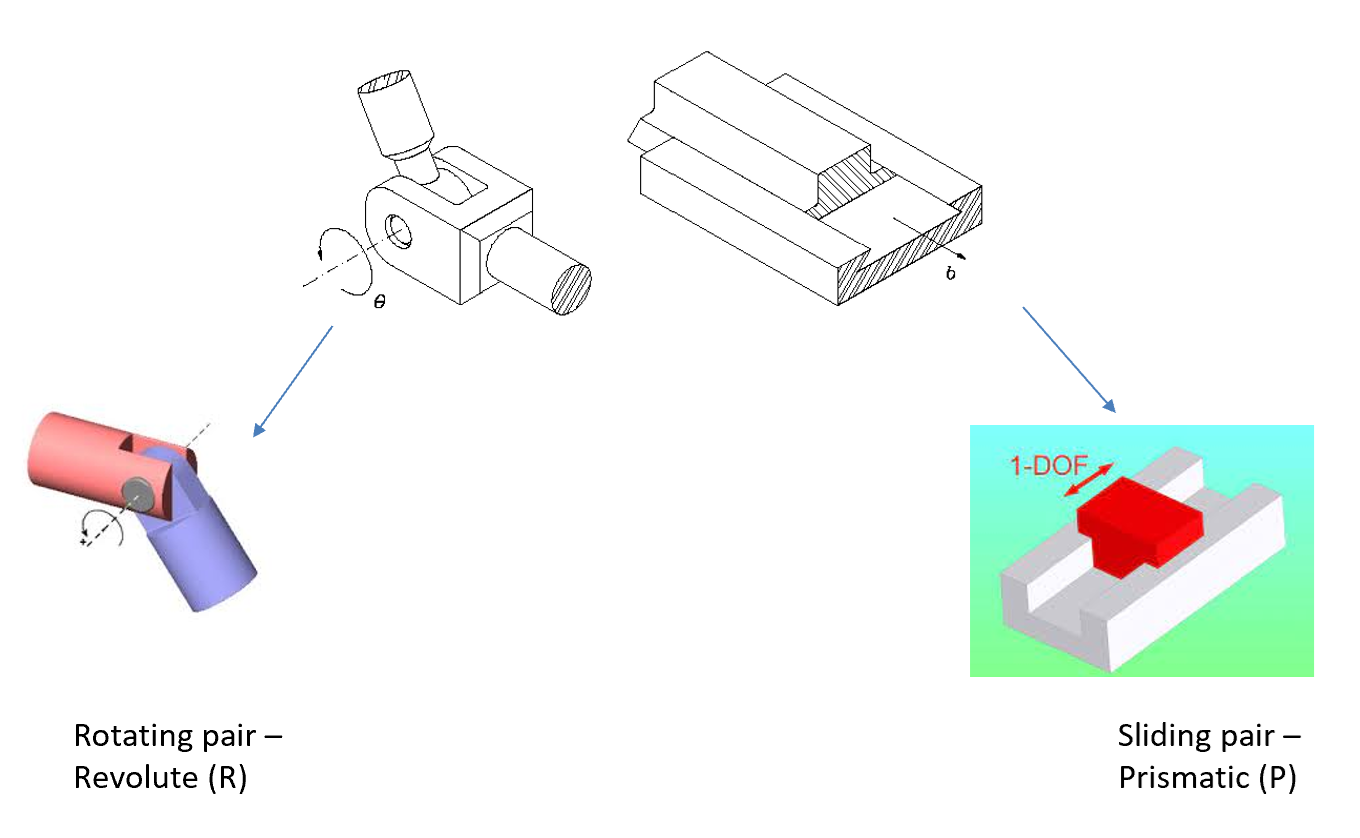
Many real robotic mechanisms can be described by combinations of these two basic joint types.
What Is a Kinematic Chain?
A kinematic chain is a sequence of links connected by joints:
Link + Joint → Kinematic Chain
The links represent rigid bodies, while the joints represent the kinematic connections between them.
Kinematic chains can have different configurations. For example, a mechanism may form an open chain or a closed chain.
In an open kinematic chain, there is a sequence of links and joints extending from the base to the end effector.
A typical industrial robotic arm is an example of an open-chain manipulator.
Joint Space and Task Space
Two important concepts in robotics are joint space and task space.
Joint Space
Joint space describes the robot using its joint variables.
For example:
- θ₁ = joint 1 angle
- θ₂ = joint 2 angle
- θ₃ = joint 3 angle
The complete set of joint variables describes the configuration of the robot.
Task Space
Task space describes the position and orientation of the robot’s end effector.
Depending on the robot, this may include Cartesian coordinates such as x, y and z
and orientation variables.
Understanding the relationship between these two spaces is one of the central goals of robot kinematics.
What Is the End Effector?
The end effector is the component at the end of a robot manipulator that interacts with the environment.
For an industrial robotic arm, the end effector could be:
- A gripper
- A welding tool
- A drill
- A suction tool
- A camera
- Another specialised robotic tool
When we discuss the position and orientation of a robot, we are often interested specifically in the position and orientation of its end effector.
Forward Kinematics
One of the two fundamental problems in robot kinematics is forward kinematics.
What is forward kinematics?
Forward kinematics determines the position and orientation of the end effector from the robot’s joint variables.
In simple terms:
Joint angles/displacements → End-effector position and orientation
A simple example
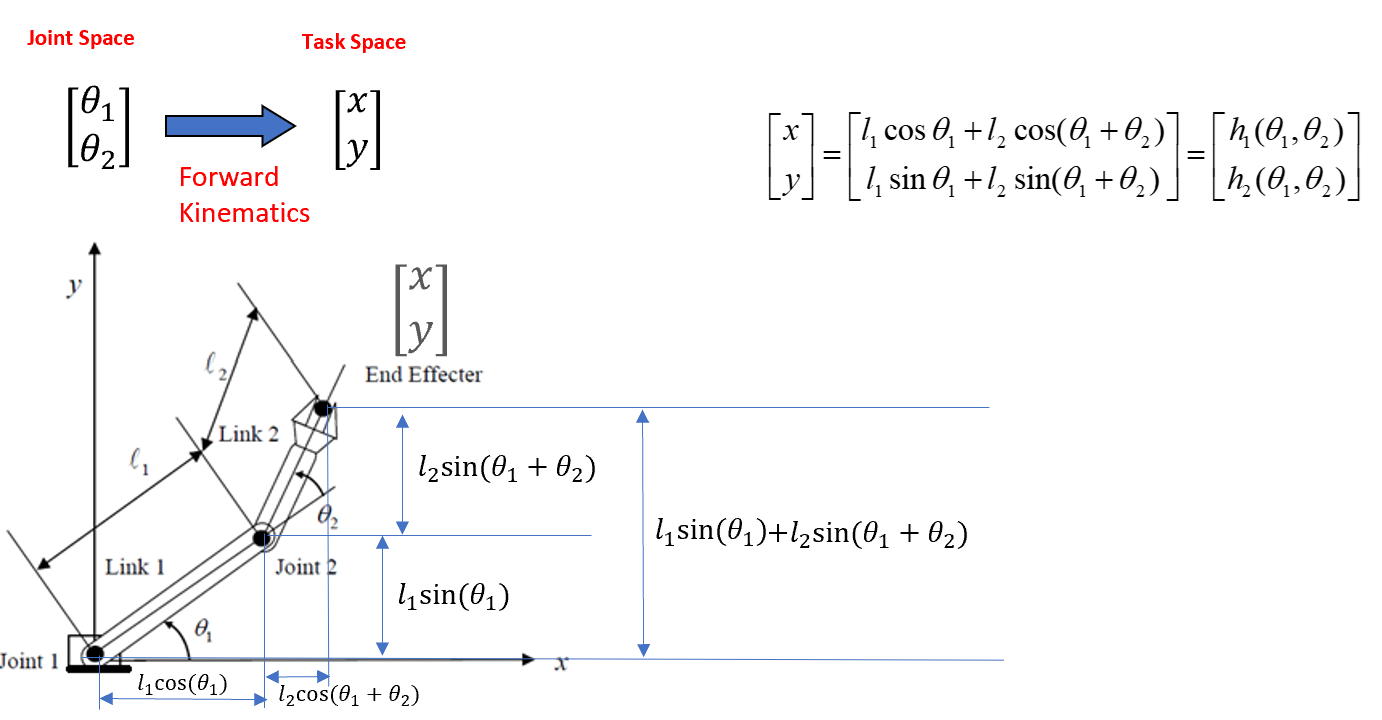
Imagine a simple planar robotic arm with two revolute joints.
If we know:
- The length of link 1
- The length of link 2
- The angle of joint 1
- The angle of joint 2
we can calculate where the end of the second link is located.
This is the basic idea behind forward kinematics:
Why is forward kinematics useful?
Forward kinematics can be used to determine where a robot’s tool is located when the robot controller knows the current joint positions.
For example, a robot controller may know:
Joint 1 = a particular angle
Joint 2 = a particular angle
The forward kinematics calculation can then determine the corresponding Cartesian position of the end effector.
Inverse Kinematics
The second fundamental kinematic problem is inverse kinematics.
Inverse kinematics works in the opposite direction.
What is inverse kinematics?
Inverse kinematics calculates the joint variables required to place the end effector at a desired position and orientation.
In simple terms:
Desired end-effector position → Required joint angles/displacements
Why is inverse kinematics important?
Suppose you want a robotic arm to move its gripper to a specific location.
You know where you want the gripper to go, but the robot needs to determine:
How should each joint move?
Inverse kinematics provides the mathematical relationship needed to answer this question.
This makes inverse kinematics particularly important for robot control and motion planning.
Forward vs Inverse Kinematics
The easiest way to remember the difference is:
| Problem | Given | Calculate |
|---|---|---|
| Forward kinematics | Joint variables | End-effector position/orientation |
| Inverse kinematics | End-effector position/orientation | Joint variables |
The direction of the calculation is therefore reversed.
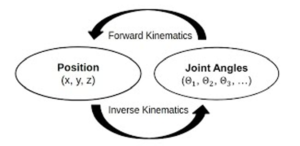
Forward kinematics
Joint Space → Task Space
Inverse kinematics
Task Space → Joint Space
This relationship is one of the most important concepts for anyone learning robotics.
A Simple Planar Robot Example
Consider a simple robot operating in a two-dimensional X-Y plane.
Suppose the robot has a combination of revolute and prismatic joints.
The robot’s configuration can be described by its joint variables, while the position of its end effector can be described using Cartesian coordinates such as x and y.
For forward kinematics, we start with the robot’s joint configuration and determine (x, y)
For inverse kinematics, we start with the desired (x, y), and determine the joint variables required to reach that position.
This simple example illustrates the fundamental relationship between joint space and task space.
Transformation Matrices in Robotics
Another important concept in robot kinematics is the transformation matrix.
Robots frequently need to describe the position of one point or coordinate frame relative to another.
For example, imagine that a point is described in coordinate frame {1}, but we need to determine its coordinates relative to coordinate frame {0}.
A transformation allows us to express the point in the new reference frame.
Translation in 2D
A translation changes the position of a point without changing its orientation.
For example, if a point is translated by an offset:
(dx, dy)
its coordinates change according to that displacement.
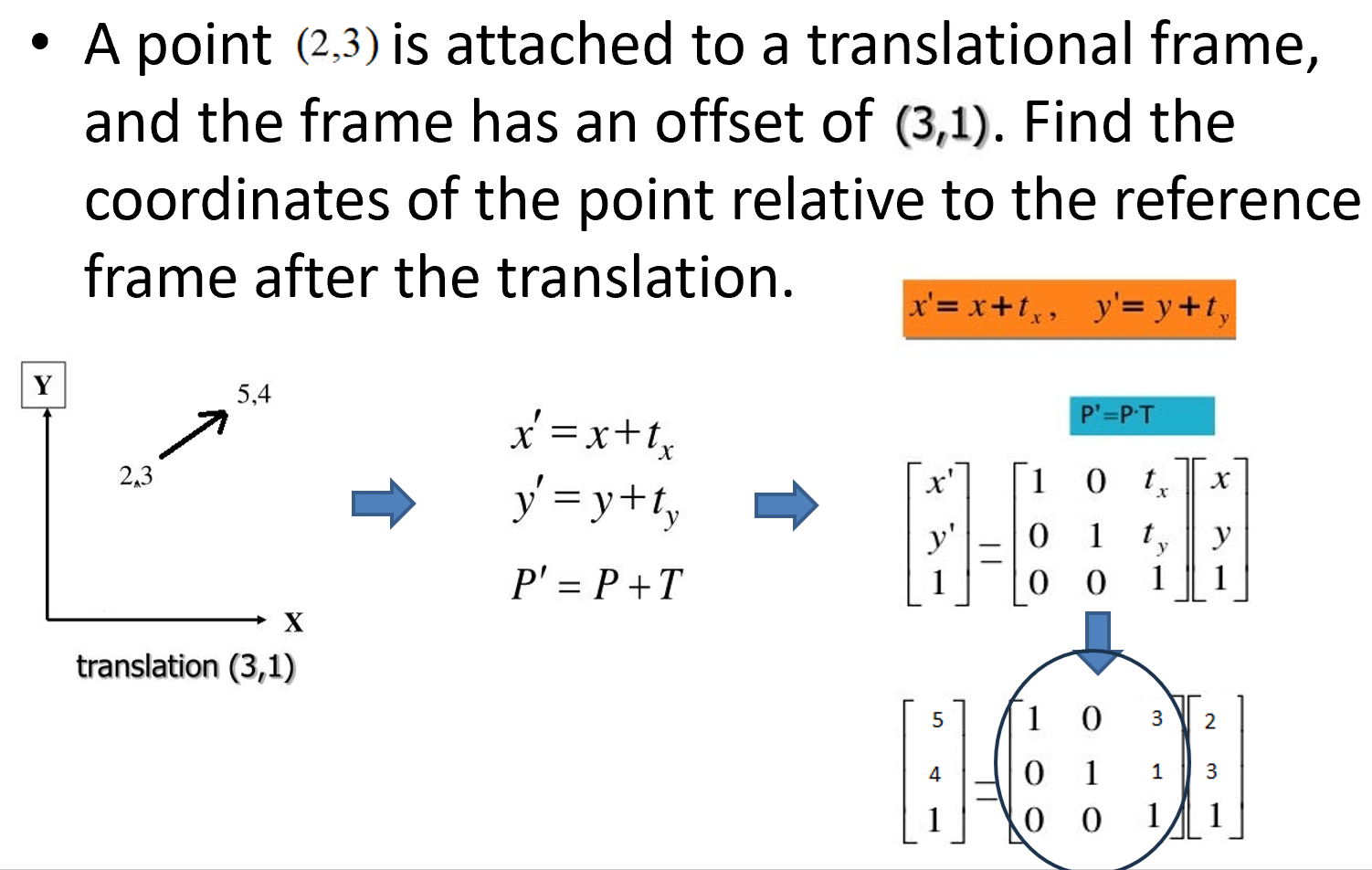
This illustrates how transformation mathematics can be used to move between coordinate descriptions.
Why Are Transformation Matrices Important?
Transformation matrices are particularly useful because robot motion is rarely limited to one simple movement.
A robotic system may need to combine:
- Translation
- Rotation
- Multiple coordinate frames
- Multiple robot links
- Multiple joints
Transformation matrices provide a systematic mathematical way to combine these operations.
Three important advantages:
1. Combining transformations
Multiple transformations can be combined through matrix multiplication, allowing complex transformations to be represented systematically.
2. Homogeneous coordinates
Translation can be represented elegantly using homogeneous coordinates, allowing translation to be incorporated with other transformations such as rotation.
3. Efficient calculations
Although adding a translation vector can appear simpler for a single translation, matrix representations become particularly useful when multiple transformations must be combined or reversed.
How Robot Kinematics Fits Together
The concepts introduced in robot kinematics are closely connected.
A simplified picture is:
Robot joints
↓
Joint variables
↓
Kinematic model
↓
Transformation calculations
↓
End-effector position and orientation
Forward kinematics follows this direction.
For inverse kinematics, the process is reversed:
Desired end-effector position and orientation
↓
Kinematic model
↓
Joint variables
↓
Robot configuration
This relationship is fundamental to how robotic manipulators are mathematically modelled and controlled.
Why Learn Robot Kinematics?
Robot kinematics provides the mathematical foundation for many areas of robotics.
Understanding kinematics helps students and engineers move from simply knowing that a robot can move to understanding exactly how its joints produce that movement.
It is particularly relevant to:
- Robotic arms
- Industrial robots
- Autonomous robots
- Robot motion planning
- Robot control
- Manipulator design
- Computer vision and robotics
- AI and robotics
- Educational robotics
For students learning robotics, forward and inverse kinematics are especially important because they provide a bridge between mathematical models and real robot movement.
Key Takeaways
Let’s summarise the most important concepts.
Robot kinematics
Studies robot motion without focusing on force and mass properties.
Joint variables
Describe the configuration of a robot’s joints.
Revolute joint
Produces rotational movement.
Prismatic joint
Produces linear sliding movement.
Kinematic chain
A sequence of links connected by joints.
Joint space
Describes a robot using its joint variables.
Task space
Describes the position and orientation of the robot’s end effector.
Forward kinematics
Calculates the end-effector position and orientation from the joint variables.
Inverse kinematics
Calculates the required joint variables from the desired end-effector position and orientation.
Transformation matrices
Provide a systematic way to represent and combine transformations between coordinate frames.
Start Learning Robotics
Robot kinematics may initially appear mathematical, but the underlying idea is straightforward:
We want to understand the relationship between how a robot’s joints move and where its end effector goes.
Once you understand joint space, task space, forward kinematics, inverse kinematics and coordinate transformations, you have established an important foundation for more advanced robotics topics like AI and Coding
At Matris Robotic, robotics education combines theoretical concepts with practical learning to help students develop a deeper understanding of robotics, coding and artificial intelligence.
If you are a student, parent, teacher or robotics enthusiast looking to develop practical robotics skills, exploring kinematics is an excellent place to start.
Frequently Asked Questions
What is robot kinematics?
Robot kinematics is the study of the motion of robotic mechanisms without considering the forces and masses responsible for that motion.
What is forward kinematics?
Forward kinematics determines the position and orientation of a robot’s end effector from its joint variables.
What is inverse kinematics?
Inverse kinematics determines the joint variables required to achieve a desired end-effector position and orientation.
What is the difference between joint space and task space?
Joint space describes the robot using its joint variables, while task space describes the position and orientation of its end effector.
What are revolute and prismatic joints?
A revolute joint produces rotational motion, while a prismatic joint produces linear sliding motion.
Why are transformation matrices used in robotics?
Transformation matrices provide a mathematical framework for describing and combining translations and rotations between coordinate frames.
Is robot kinematics important for learning robotics?
Yes. Kinematics is a fundamental part of robotics because it provides the mathematical relationship between robot joint movement and end-effector motion.