
How Matris Personalises Learning for Creative and Practical Experience
At Matris Robotic, we teach Robotics, AI and Coding to children (5-16 years old). Matris does not use a one-size-fits-all curriculum. Students progress through structured levels, but the content, pace, support, and challenge can be adapted according to their existing knowledge, interests, and development.
We have been teaching robotics and coding since 2012, continually updating our programmes each term to reflect new developments and students’ learning needs. This commitment to innovation led to collaboration of co-founder with UCL’s Department of Computer Science in 2023 on the “Bio-Robots: Crawl, Jump, and Slither!” project.
We adapt our teaching to each student’s progress, abilities, and level of engagement, creating an effective learning experience that supports their individual development. Each level of our curriculum is supported by carefully selected teaching materials designed to meet students’ individual learning needs.
Through engaging activities such as games, coding, and robotics, students develop creativity, concentration, problem-solving skills, and confidence while learning how to apply their knowledge and skills to real-world situations.
 1- Robotics Curriculum
From Guided Builds to Independent Innovation
As students progress through our robotics programme, they develop not only technical skills but also problem-solving abilities, teamwork, creativity, and confidence. Our approach ensures that every student is appropriately challenged and supported, allowing them to learn at their own pace while developing greater independence.
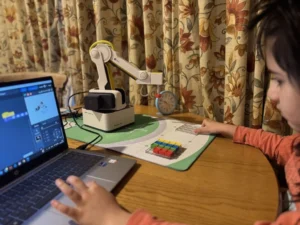
In the guided-build sessions, students learn to construct different robots using step-by-step instructions. This hands-on process helps develop their concentration, attention to detail, and understanding of how different mechanisms work. Once a robot is completed, students troubleshoot, test, and refine their creations, learning to identify problems and find practical solutions.
In the following session, students take part in a creativity challenge, applying the mechanisms and techniques they have learned to design and build a new robot based on their own ideas, without following step-by-step instructions. At first, teachers provide guidance and encouragement, helping students turn their ideas into workable designs. As their skills and confidence grow, students gradually take greater ownership of the process, eventually designing and building their own robots independently.
2- AI & Coding Curriculum
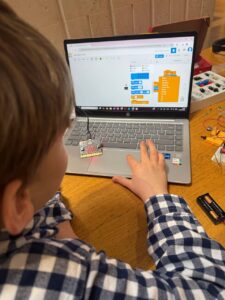
Every student begins their AI & Coding journey with a different level of knowledge, experience, and confidence. At Matris Robotic, we adapt the learning experience to meet each student where they are, adjusting the level of challenge, pace, and support as they progress.
Students first build strong foundations through guided, hands-on activities in coding, electronics, engineering, and Artificial Intelligence. Using tools such as Tinkercad and block-based programming, they explore how circuits, sensors, smart systems, and code work together. As their understanding develops, they can progress towards more advanced programming, including Python, and begin working with microcontrollers, sensors, motors, and real-world systems to make them smart.
Our approach combines structured learning with creative exploration. Students receive clear guidance when learning new concepts, followed by opportunities to experiment, troubleshoot, modify projects, and develop their own ideas. Their interests can also help shape the projects they work on, from building smart systems to creating games, animations, and interactive applications.
As students become more confident, the learning experience gradually shifts from following instructions towards making independent decisions. They learn to design solutions, test their ideas, identify problems, and improve their projects through iteration.
Personalised Learning, From Foundations to Innovation
1 Comment.
[…] At the British Library, two Robotics & Coding workshops: 10:30 AM–12:00 PM and 12:30 PM–2:00 PM, plus a university student […]